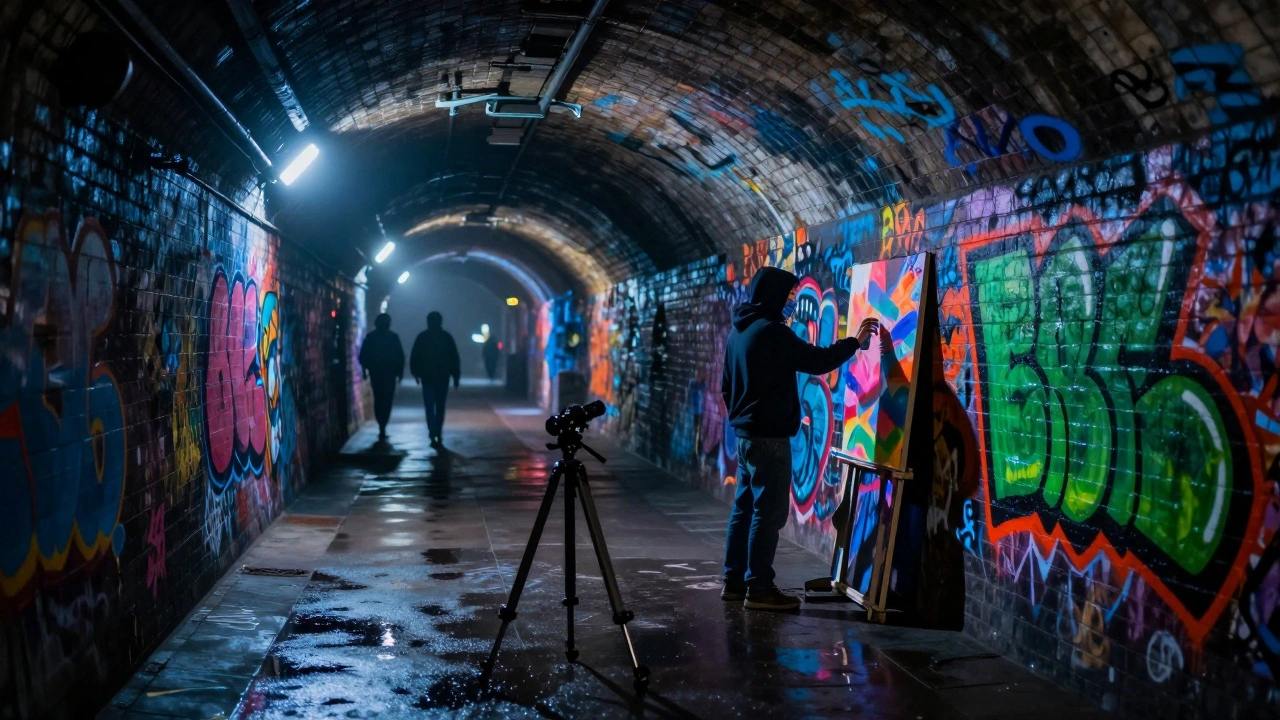
London doesn’t sleep. Not really. While most people are home watching TV or scrolling through their phones, the city’s walls are changing. Spray cans hiss. Stencils snap into place. Brushes sweep across brick. By morning, a hidden mural is gone - replaced by something bolder, louder, more alive. If you want to see that transformation happen in seconds, not days, you need to shoot a time-lapse. And London? It’s one of the best cities in the world to do it.
Where the Walls Come Alive
Not every alley in London is worth your camera. Some spots are quiet. Some are clean. Some are just boring. But a few places? They’re living galleries. Every week, new artists show up. Some are local. Some fly in from Berlin, Tokyo, or New York. They don’t ask permission. They don’t wait for permits. They just paint.
Start at Leake Street Tunnel under Waterloo Station. This isn’t just a tunnel - it’s a sanctioned canvas. The city actually encourages it. You’ll find pieces that last a day, or ones that stick around for months. The lighting here is perfect for time-lapse: dim at night, glowing under LED strips, with layers of paint building up like a living collage. Set up your tripod at the far end, facing the main archway, and let your camera roll from 9 p.m. to 5 a.m. You’ll catch artists working in silence, shadows moving like ghosts, colors bleeding into each other. One night last October, a piece started as a single red line. By dawn, it was a 30-foot tiger with glowing eyes. No one knew who did it. No one cared. Everyone stopped to stare.
Camden’s Backstreets: Chaos with Purpose
Camden Market draws tourists. But the real art? It’s in the alleys behind the stalls. Walk past the dumpling shops, turn left at the broken neon sign, and you’ll hit the wall between Camden Lock and the canal. This spot changes every 48 hours. Artists come here because it’s visible, but not policed. The wall gets repainted so often, the brick underneath is almost gone. You’ll see tags from 2023 still faintly visible under fresh layers - like a fossil record of street art.
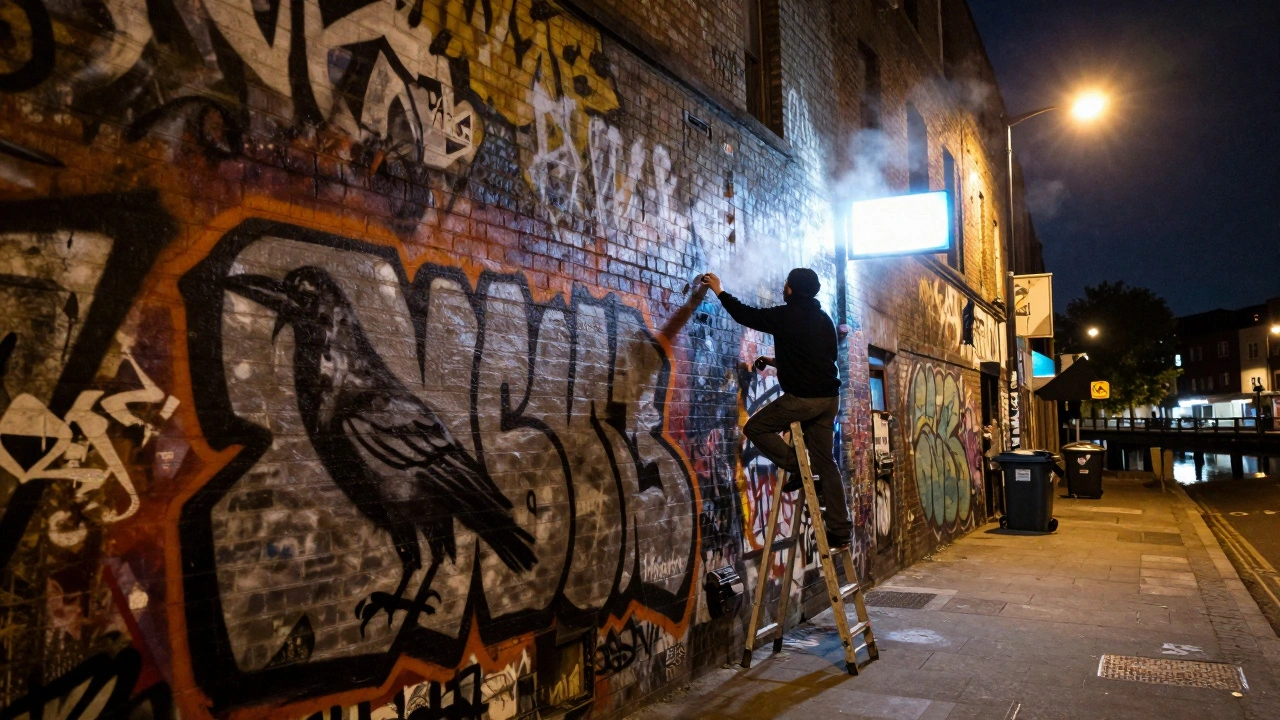
Best time to shoot? Friday night. That’s when the local crews show up. They work fast. One artist I watched used a ladder, a bucket of spray paint, and a single stencil of a crow. He did the whole thing in 17 minutes. Then he walked away. No photos. No fanfare. Just the sound of the spray can clicking off. Your time-lapse will show the crow appearing, then vanishing, then being replaced by a dragon with wings made of broken glass. That’s Camden. No rules. Just rhythm.
Shoreditch: The Gallery That Never Closes
Shoreditch used to be the heart of London’s underground scene. Now it’s packed with coffee shops and Instagram influencers. But if you know where to look, the soul’s still there. Head to the side of the old Hoxton Square car park - the one with the rusted chain-link fence. That’s where the real artists still work. The fence is covered in layers of paint, stickers, and metal cutouts. It’s not a wall. It’s a collage of voices.
Try shooting between 10 p.m. and 2 a.m. That’s when the night shift painters come out. They don’t use ladders. They climb the fence. They work with gloves, hoodies, and flashlights. One night, I saw a woman paint a face - just eyes and lips - over a faded Banksy-style child holding a balloon. The next morning, the balloon was gone. But the eyes? Still there. Watching. That’s the magic of time-lapse. You don’t just capture art. You capture the moment it was taken.
East London’s Hidden Walls
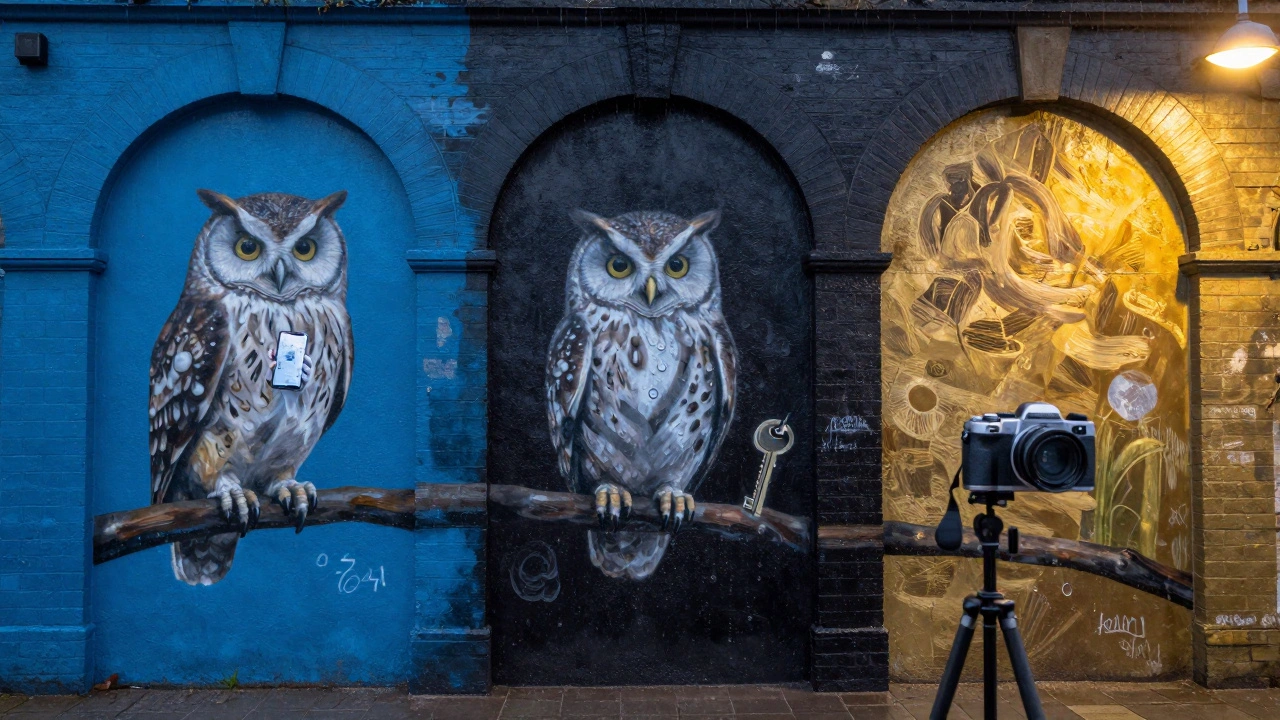
Forget the big names. The best stuff is often tucked away. Walk down the side of the old railway arches near Hackney Wick. There’s a wall behind the graffiti-covered train shed - no sign, no name, just a chain-link gate. It’s been painted every week since 2020. Some artists come back year after year. One guy, known only as “Kilo,” has painted the same owl on this wall every March since 2021. Each year, the owl gets bigger. Each year, it’s holding something different - a phone, a key, a tiny London bus. In 2024, it was holding a camera. You know what that means.
Set your time-lapse to capture a full month. You’ll see the owl grow. You’ll see the background shift from blue to black to gold. You’ll see the same artist return, week after week, adding one brushstroke at a time. It’s not just art. It’s a diary. And you’re the one holding the camera.
What Gear You Actually Need
You don’t need a $3,000 camera. You don’t need a drone. You just need three things: a tripod, a camera with manual settings, and patience.
- Tripod: Get one that won’t wobble. London wind? It’s real. A cheap tripod will shake during your 4-hour shoot. Spend the extra £30. A Manfrotto or Joby will hold steady.
- Camera: Any DSLR or mirrorless with manual mode works. Set your aperture to f/8, ISO to 400, shutter speed to 1/15. Shoot in RAW. You’ll thank yourself later.
- Intervalometer: This is the secret. Most cameras let you set intervals. Set it to take a photo every 15 seconds. That gives you 96 photos per hour. For a 6-hour shoot? 576 frames. That’s 24 seconds of video at 24fps. Smooth. Real.
Don’t forget a spare battery. And a rain cover. London doesn’t wait for your schedule. I lost a full night’s shoot in 2023 because I forgot the cover. Rain turned a perfect mural into a muddy smear. You don’t want that.
When to Go - And When Not To
Timing matters. You don’t want to show up and get chased off by security. Or worse - arrested.
- Best nights: Thursday to Sunday. Artists work weekends. Weeknights are quiet. You’ll see more action on Friday and Saturday.
- Avoid: Monday and Tuesday. Most crews take those days off. The walls stay the same. Your time-lapse will be boring.
- Best months: March to October. Warmer nights. Longer hours. Winter? It’s possible, but the paint doesn’t dry right. You’ll get smudges, not masterpieces.
And here’s the rule: never get too close. Shoot from the sidewalk. Don’t block the path. Don’t shine a light in their eyes. These artists don’t want attention. They want their work to live. Respect that.
What Happens After You Shoot
You’ve got your 576 frames. Now what?
Use free software like DaVinci Resolve or even Adobe Express. Import the images. Set the frame rate to 24fps. Render. That’s it. You don’t need fancy effects. The art speaks for itself.
Post it online. Tag the location. Don’t name the artist - they don’t want to be found. But do say where it happened. Someone else will go. And that’s the point. Street art isn’t meant to be locked away. It’s meant to be seen. Shared. Remembered.
Why This Matters
Street art isn’t vandalism. It’s history. Every mural in London is a timestamp. A mood. A protest. A love letter. A cry for help. When you capture it in time-lapse, you’re not just recording paint. You’re recording a city breathing.
Look at the wall in Leake Street from 2021 to now. You’ll see the pandemic’s shadow - more masks, more hands reaching out. You’ll see the climate protests - melting icebergs, rising seas. You’ll see the rise of digital art - QR codes hidden in murals that lead to audio poems.
These aren’t just pictures on a wall. They’re the pulse of London. And if you’re willing to wake up at 3 a.m., set up your camera, and wait - you’ll see it.
Is it legal to film street art in London?
Yes - as long as you stay on public property and don’t interfere with the artists. Filming from the sidewalk is fine. Climbing fences or trespassing isn’t. Some spots, like Leake Street Tunnel, are officially sanctioned. Others are gray zones. If you’re asked to leave, leave. No argument. Your footage isn’t worth a fine.
What’s the best camera for street art time-lapse?
You don’t need the latest model. A Canon EOS M50, Sony a6100, or even a used Nikon D3500 will work. The key is manual controls and the ability to shoot RAW. Use an intervalometer - either built-in or as a cheap external trigger. A smartphone can work too, but only with a pro app like ProCam or Filmic Pro. Don’t rely on auto settings - the light changes too fast.
How long should a time-lapse be to capture street art?
For most murals, shoot for 4 to 6 hours. That gives you enough frames to show the full process - from sketch to finish. If you’re capturing a multi-day piece, extend to 12 hours. Don’t go longer than that. The light changes too much, and the paint dries. You’ll end up with flickering shadows, not art.
Can I sell my street art time-lapse videos?
Technically, yes - but it’s complicated. The artwork itself is protected under UK copyright law, even if it’s illegal. You own the video, but not the image on the wall. Don’t sell it as "art by [artist name]." Instead, sell it as "a time-lapse of street art in London." Keep it vague. Don’t name artists. Don’t claim ownership of the design. Most artists won’t care - as long as you’re not profiting directly off their work.
What’s the biggest mistake people make shooting street art time-lapse?
Thinking the art is the only thing that matters. The real story is the process. The silence. The movement. The way a spray can sounds when it’s almost empty. The way the light hits wet paint. Don’t zoom in too close. Leave space for the environment - the alley, the streetlights, the rain. That’s what makes it real.
Go out after dark. Find a wall that’s changing. Set up your camera. Walk away. Let the city do its work. When you come back, you won’t just have a video. You’ll have proof that London never stops creating - even when no one’s watching.