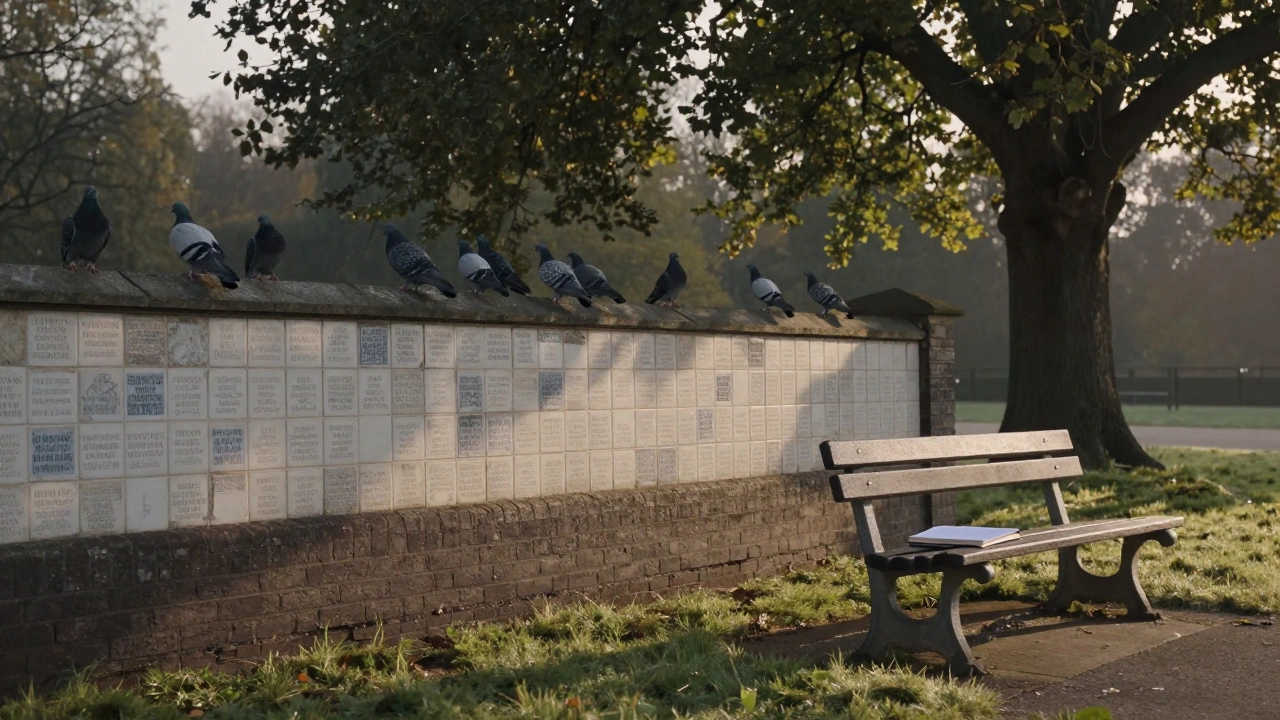
Walk past the bustle of St. Paul’s Cathedral and the clatter of commuters near Liverpool Street, and you’ll find a place that feels like it stopped in time. Postman’s Park isn’t just a park-it’s a quiet graveyard of ordinary heroism, lined with ceramic tiles that tell stories of people who died saving others. No grand statues. No military honors. Just simple tiles, each bearing a name, a date, and a moment of courage that ended too soon.
What Makes Postman’s Park Different?
Most parks in London are for picnics, dog walks, or lunch breaks. Postman’s Park is for reflection. It was created in 1880 by combining the churchyards of St. Botolph’s Aldersgate and St. Botolph without Aldersgate. The name comes from the nearby General Post Office, where postal workers once walked through the grounds on their lunch breaks. But what makes it unforgettable isn’t its history-it’s the Memorial to Heroic Self-Sacrifice.
Designed by artist George Frederic Watts in 1900, the memorial was his way of honoring everyday people who gave their lives to save others. Not soldiers. Not firefighters. Just ordinary folks: a woman who pulled a child from a burning house, a boy who jumped into a river to save a drowning friend, a nurse who stayed with patients during a cholera outbreak. Each act was small, quiet, and deadly.
Watts believed these acts mattered more than battles or politics. He wrote: “The greatest of these is love.” And that’s why the memorial exists-not to glorify fame, but to remember the quietest kind of bravery.
The Tiles That Tell Stories
There are 54 ceramic plaques on the wall today. Each one is a fragment of a life cut short. The tiles are arranged in rows, like a mosaic of sacrifice. Some are faded. Others are newly added. The oldest, from 1900, reads:
“To save a child from being run over by a cart, he ran into the road and was himself killed.” - William Hawes, 1899
Another:
“Died saving a child from drowning in the Regent’s Canal.” - Sarah Ann Haynes, 1899
One of the most haunting is for Alice Ayres, a 21-year-old servant who climbed a burning building in 1885 to rescue three children. She died in the flames. Her plaque says:
“She died saving three children from a burning house.”
No last names. No titles. Just the act. No one knew these people before they died. But now, their names are carved in porcelain, under the open sky, where pigeons land and tourists pause.
Why So Few Tiles?
You might wonder why there are only 54. Watts planned for hundreds. He wanted a wall that stretched the length of the park. But after he died in 1904, funding dried up. The memorial was never finished. The church didn’t have the money. The public didn’t rally behind it like they did for war memorials.
Even today, the memorial remains incomplete. Only the first 25 years of proposed additions were installed. The rest? Empty space. It’s a silent reminder: heroism doesn’t always get remembered. Sometimes, it just disappears.
There’s a quiet power in that. You don’t need a statue to be remembered. You just need someone to care enough to write your story on a tile.
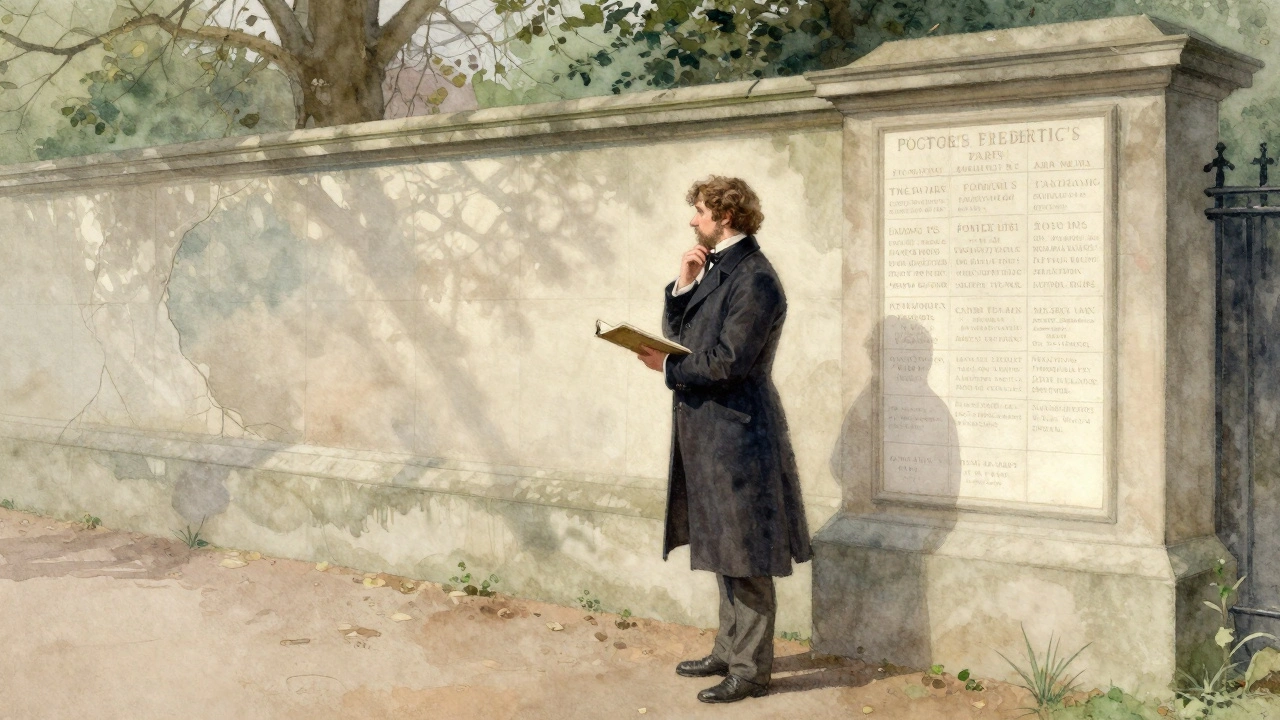
Who Was George Frederic Watts?
Watts wasn’t just an artist. He was a philosopher with a brush. Born in 1817, he painted mythological scenes and portraits of Victorian elites-but he cared most about moral themes. His famous painting “Hope” shows a blindfolded woman on a globe, strumming a broken lyre. It’s not a happy image. But it’s honest.
He didn’t like the glorification of war. He didn’t want monuments to generals. He wanted to honor the people who didn’t ask for fame. That’s why Postman’s Park is so rare. It’s the only public memorial in London dedicated to civilian courage.
Watts also funded the memorial himself at first. He donated the land, the design, and the first tiles. He even wrote the inscriptions. His wife, Mary Fraser-Tytler, kept the project alive after his death, adding tiles until 1931. But then, it stopped. No one else took over.
Visiting Postman’s Park Today
It’s easy to miss. No signs point to it. No crowds gather. You’ll find it tucked between a post office, a church, and a row of offices. The park is small-barely the size of a tennis court. There’s a bench under a tree. A few flower beds. A water fountain that still works.
Most visitors come for the tiles. They stand quietly, reading. Some take photos. Others just sit. It’s the only place in central London where you can hear your own thoughts.
The tiles are arranged in chronological order. Start at the left. Walk slowly. Read each one. You’ll find stories from 1869 to 1931. A man who drowned trying to save a girl from a flooded cellar. A woman who pulled a child from a railway track. A boy who climbed a chimney to rescue a cat and fell to his death.
There’s no entry fee. No guided tour. No audio guide. Just silence and the wind.
Why This Place Still Matters
In 2026, we live in a world of viral moments and instant fame. We post our good deeds online. We get likes for charity runs. We celebrate heroes with hashtags.
Postman’s Park doesn’t do that. It doesn’t ask for attention. It doesn’t need a crowd. It just remembers.
It’s a counterpoint to the noise. A quiet protest against forgetting.
These people didn’t die for a cause. They died because they acted. They didn’t wait for permission. They didn’t think about risk. They just did what anyone with a heartbeat would do.
And now, they’re remembered-not as saints, not as celebrities, but as human beings who chose kindness over safety.

How to Find It
Postman’s Park is in the City of London, near the intersection of Aldersgate Street and Little Britain. The nearest tube is St. Paul’s (Central line) or Barbican (Circle, Hammersmith & City, Metropolitan). Walk down the alley between the church and the old post office building. You’ll see a low brick wall with tiles. That’s it.
Best time to visit? Early morning or late afternoon. The light hits the tiles just right. The park is empty. You can read every name without distraction.
Bring a notebook. Write down one name. One story. That’s all you need.
What Else Is Around
Don’t rush away. The area is full of quiet history. Walk five minutes to the Museum of London, where you can see the original plaster models Watts used for the tiles. Or head to the Guildhall Art Gallery, which holds his larger paintings.
There’s also the church of St. Botolph without Aldersgate, where Watts is buried. His grave is unmarked. No plaque. Just a patch of grass.
It feels fitting.
Final Thought
Postman’s Park doesn’t shout. It doesn’t need to. It’s not a tourist attraction. It’s a mirror. When you read those tiles, you’re not just learning about the past. You’re asking yourself: What would I have done?
Would you have run into the fire? Would you have jumped into the water? Would you have stayed when everyone else ran?
There’s no answer written on the tiles. But the question remains.
Is Postman’s Park free to visit?
Yes, Postman’s Park is completely free to visit. There are no tickets, no opening hours, and no entry restrictions. It’s open daily from dawn to dusk, like most public parks in London.
Are the memorial tiles original?
Most of the tiles are original, dating from 1900 to 1931. They were made by William De Morgan, a famous ceramicist known for his detailed glazes. A few tiles were replaced in the 1990s due to weather damage, but the inscriptions and designs were kept faithful to the originals.
Why are there no names on the tiles?
The memorial only lists the person’s first name and the act of heroism, not their full name or family details. This was intentional. George Frederic Watts wanted to focus on the act, not the identity. He believed the sacrifice itself was what mattered-not who they were before they died.
Can new tiles be added to the memorial?
No new tiles have been added since 1931. The memorial was never officially completed, and no organization currently manages additions. While some have proposed expanding it, there’s no formal process or funding to do so. The existing 54 tiles remain unchanged as a historical artifact.
Is Postman’s Park part of the City of London?
Yes, Postman’s Park lies within the City of London, the historic and financial heart of the city. It’s surrounded by offices, banks, and churches that date back to the 17th century. Despite being in the middle of a busy business district, the park remains untouched by modern development.